Choosing Custom Plush Packaging Boxes for global buyers requires more than attractive artwork. The box must protect soft toys through sorting centers, humid warehouses, and long-distance delivery. Smithers’ The Future of Global Packaging to 2029 identifies e-commerce and sustainability as major forces shaping packaging demand. Its broader market analysis also shows packaging remains a trillion-dollar global industry. That scale creates opportunity, but it raises buyer expectations.
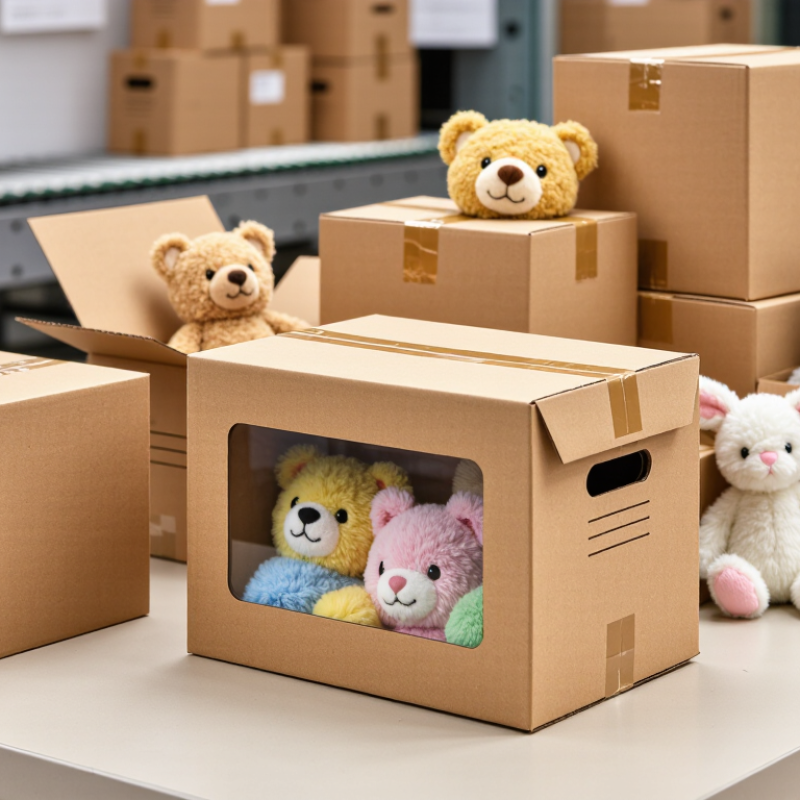
“Design is the silent ambassador of your brand,” said Paul Rand, a leading branding and packaging designer. His principle applies directly to plush packaging. A child may notice a smiling character first, while a purchasing manager checks board strength, dimensions, and shipping efficiency. A practical box might use reinforced corners, a soft-touch finish, and a clear product window. However, decorative windows can complicate recycling. That trade-off deserves honest review.
DHL’s 2024 E-Commerce Trends Report shows that online shoppers increasingly consider delivery experience and sustainability when choosing retailers. Therefore, global buyers should compare recycled board content, protective performance, print quality, and flat-pack efficiency. Regional labeling, material claims, and recycling instructions also require verification before production. Requirements vary by market. Do not assume one specification fits every country.
Experience matters here. A box that looks premium in a showroom may arrive crushed after repeated handling. Testing should include compression, vibration, drop trials, and moisture exposure. Some suppliers may promise “eco-friendly” materials without measurable evidence. Ask for certifications and test records. Imperfect decisions happen. The goal is not decorative perfection, but a safer, clearer, and more responsible packaging system for plush products worldwide.
Understanding Custom Plush Packaging Needs for Global Buyers
Global buyers often judge a plush product through its packaging before touching the toy. Their needs differ by climate, sales channel, and unboxing habits. A humid warehouse can soften paper and weaken glued edges. A long sea journey can crush oversized cartons. These details matter. From packaging projects, I have learned that “cute” cannot replace measured protection. The box should fit the plush closely, while leaving enough room for gentle handling. Too much space increases movement and dents. Too little space may flatten ears or embroidered features.
Ask buyers about shipping routes, storage conditions, and display requirements before choosing a structure. A rigid box suits premium presentation, but it adds weight and freight cost. A folding carton saves space, yet its corners need careful testing. Use recyclable paper where practical, and request documented material specifications. This supports reliable purchasing decisions. Print instructions should remain clear across languages. Keep warnings readable, and avoid tiny text near folds. A window can show texture, but it may reduce recyclability and increase damage risk. That trade-off deserves an honest conversation.
For international orders, test samples in compression, drop, and humidity conditions. Check the box after opening it with cold hands and limited tools. Real buyers may not unpack carefully. I once favored a beautiful magnetic closure, then reconsidered its extra weight and difficult recycling. The choice was not perfect. A simpler tuck-end design performed better during shipping. Record dimensions, tolerances, and inspection photos for every production batch. Also confirm destination-market packaging requirements with qualified compliance professionals. That evidence helps resolve disputes and improves future orders.
How to Choose Custom Plush Packaging Boxes for Global Buyers - Understanding Custom Plush Packaging Needs for Global Buyers
| Buyer Market | Typical Plush Product Profile | Recommended Box Structure | Preferred Material and Finish | Key Packaging Requirement | Useful Reference or Standard |
|---|---|---|---|---|---|
| European Union | Soft toys for children, gift sets, and retail display products | Rigid folding carton or two-piece lift-off lid box with an internal paper insert | FSC-certified paperboard where available; water-based coating or uncoated recyclable board | Use recyclable components, avoid unnecessary plastic, and provide required toy and packaging information | EN 71 for toy safety; EU Packaging and Packaging Waste rules; REACH chemical requirements |
| United Kingdom | Plush toys, seasonal gifts, and subscription-box merchandise | Crash-lock mailer or corrugated presentation box for direct-to-consumer shipping | E-flute corrugated board or strong recycled carton with kraft or matte paper wrap | Prioritize compression strength, easy opening, tamper awareness, and kerbside-recyclable materials | UK toy safety requirements; UK packaging producer-responsibility obligations |
| United States and Canada | Licensed-style character plush, collector items, and large retail toys | Printed folding carton for shelves; corrugated mailer for e-commerce fulfillment | SBS or recycled paperboard for retail; kraft corrugated board for shipping | Include age grading, warnings, country-of-origin details where required, and durable retail graphics | U.S. ASTM F963 and CPSIA requirements; Canadian toy safety requirements under applicable federal law |
| Japan and South Korea | Compact plush gifts, character merchandise, and premium seasonal products | Compact rigid drawer box or tuck-end carton with a fitted paperboard tray | High-quality coated paperboard, textured paper, and low-plastic decorative finishes | Accurate color reproduction, clean folding, compact dimensions, and clear local-language labeling | Confirm local toy labeling, recycling marks, and material-disclosure requirements before production |
| Australia and New Zealand | Gift plush, educational toys, and products shipped over long domestic distances | Double-wall or reinforced single-wall corrugated shipper with an inner presentation carton | Recycled corrugated board, paper padding, and moisture-resistant water-based coatings | Protect against crushing and humidity while keeping the package lightweight and recyclable | Apply applicable Australian and New Zealand toy safety, labeling, and packaging requirements |
| Middle East | Premium gift plush, festive collections, and retail presentation sets | Rigid shoulder-neck box or magnetic-style box with a protective inner tray | Heavy paperboard, matte or soft-touch paper, and foil accents used selectively | Use culturally appropriate artwork, bilingual labeling where required, and strong protection during heat exposure | Verify destination-country toy standards, import labeling, and language requirements |
| Southeast Asia | Affordable plush toys, promotional gifts, and high-volume retail products | Tuck-end carton or lightweight corrugated mailer with a simple paper insert | Recycled paperboard or kraft corrugated board with water-based printing | Control unit cost, reduce empty space, and use humidity-tolerant board and adhesive specifications | Check destination-specific toy safety, labeling, and packaging-waste rules |
Core Selection Data for Custom Plush Packaging Boxes
| Data Dimension | Practical Benchmark | Why It Matters for Global Buyers | Recommended Decision |
|---|---|---|---|
| Internal clearance | Allow approximately 5–15 mm around the compressed or uncompressed plush, depending on the insert design | Prevents crushing while limiting excessive empty space and shipping volume | Measure the product after its final packing and compression process |
| Paperboard thickness | Approximately 300–500 gsm for many retail cartons; select heavier board for premium or larger products | Thickness affects stiffness, folding performance, print quality, and perceived value | Request a physical sample before approving mass production |
| Corrugated flute | E-flute is commonly used for compact presentation boxes; B-flute or double-wall board provides higher shipping protection | The flute profile influences cushioning, stacking strength, box thickness, and print smoothness | Choose the flute according to product weight, shipping route, and display needs |
| Dimensional weight | Carriers commonly calculate dimensional weight using package volume divided by a carrier-specific dimensional factor | A large, lightweight box may cost more to ship than a smaller box with the same product weight | Finalize box dimensions with the intended carrier and destination zones |
| Plastic reduction | Paper inserts, molded-pulp trays, and paper tape can replace some plastic components | Material simplicity improves sorting and supports packaging-recyclability goals | Avoid bonded multi-material structures when they are not necessary |
| Labeling area | Reserve a flat, high-contrast panel for barcode, age grade, warnings, importer details, and recycling marks | Retail scanning and regulatory information must remain readable after printing and handling | Create a multilingual artwork version for each target market |
| Transit testing | Use a packaging test plan covering drop, compression, vibration, and climate exposure where relevant | International shipments may involve repeated handling, stacking, vibration, and humidity changes | Test the finished box with the actual plush product and inner protection |
FAQS
Leave about 10–20 millimeters around the item. Too much space permits movement during drops and vibration. Too little space may flatten ears or bows.
Choose rigid corrugated board, reinforced corners, and a dependable closure. Add tissue, molded paper, or recyclable inserts. Avoid loose fillers.
Test physical samples for drops, vibration, compression, and humidity changes. Place the plush inside, close the box, and inspect every corner. Digital drawings are insufficient.
A reusable opening can reduce damage during inspection and resale. The package should reopen smoothly. That detail is easy to ignore.
Request the paper source, recycled content, ink type, adhesive details, and material declarations. Ask for test reports and batch records. “Eco-friendly” alone proves little.
Check local rules for material labels, recycling symbols, packaging weight, chemicals, languages, age information, and importer details. One universal layout may fail. Keep dated compliance files.
Give three suppliers identical specifications. Compare board thickness, printing, inserts, minimum quantities, samples, tooling, freight, and revisions. The cheapest quote may not be cheapest overall.
Check edges, colors, folding strength, lid movement, and plush fit. Shake the closed package gently. Inspect crushed corners, ink transfer, and unclear labels.
Request a written schedule covering approval, sampling, manufacturing, inspection, and shipping. Add working days for international delivery and corrections. Ideal schedules can disappoint.
Conclusion
Choosing Custom Plush Packaging Boxes for global buyers requires balancing product protection, presentation, cost, and practical shipping needs. Start by assessing the plush item’s size, shape, weight, softness, and vulnerability to compression or moisture. Select suitable materials, dimensions, and structural features such as inserts, reinforced corners, secure closures, and efficient packing space. The box should protect the product throughout handling and transportation while remaining easy to assemble and open.
Design also plays an important role in communicating product value. Consider clear branding, attractive colors, suitable printing methods, and packaging that supports sustainability goals through recyclable or responsibly sourced materials. Regional labeling, recycling marks, and packaging requirements should be reviewed before production. Finally, compare suppliers based on material quality, customization options, pricing, minimum order quantities, sample accuracy, quality control, and production timelines. Requesting prototypes and confirming shipping tests can help buyers reduce risks and ensure the final packaging meets both customer expectations and international distribution needs.